Purified water and ice
System for water purification plants and ice factories
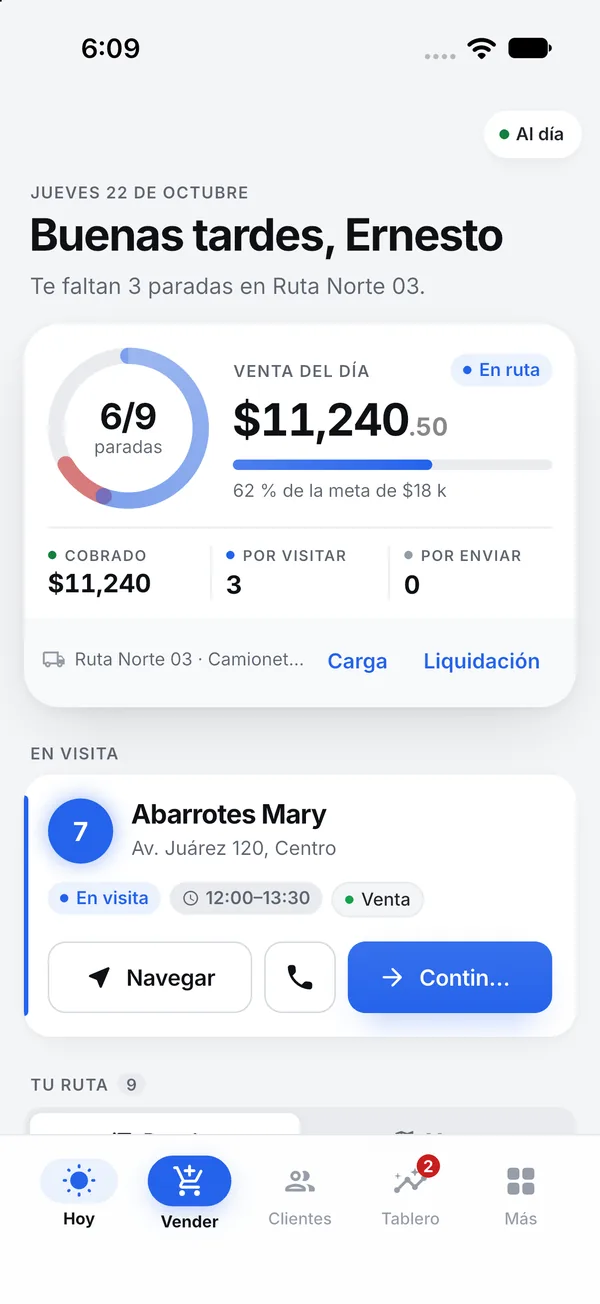
Your drivers sell water jugs and bags of ice from the app, even with no signal, and you settle the truck when they get back.
Example
A Thursday on route 2
El Manantial Water is a made-up example. It has a refill counter, two home delivery trucks and a few businesses on credit. Route 2 goes out on Tuesdays, Thursdays and Saturdays.
On Thursday morning the plan has 85 stops: the homes due that day and two offices that called in an order. The load comes from the average of what each customer has bought plus a margin. In the afternoon the driver comes back, the truck is counted and two jugs are missing. The driver says one broke and he left the other with a customer on credit without recording it. Both are logged with their cause and the cash matches what the app says.
- stops on Thursday's plan
- 85
- stops on Thursday's plan
- jugs sold on the route
- 212
- jugs sold on the route
- cash handed in at settlement
- $7,420
- cash handed in at settlement
- jugs short, each with its cause
- 2
- jugs short, each with its cause
What makes water delivery hard
Water jugs sell cheap and in volume, so any leak shows up at the end of the month: a driver who gives too much change, or a house nobody visited because the driver changed the route.
Routes aren't even either. Some homes order every eight days, a shop orders every other day and a gym only calls when it runs out. On the edge of town the signal comes and goes, and an app that freezes without internet ends up forgotten in the glove box.
Then there's loaned equipment. The dispensers and coolers you leave at offices and businesses cost as much as many months of water, and it's easy to lose track of them when a customer moves or the equipment breaks down.
If you also make ice, delivery starts earlier and goes to shops and restaurants, with freezers you also lend out. Nori handles water and ice on the same inventory and the same routes.
The plant's day
-
6:00
Day plan
In Day planning you generate the routes. Each one includes the customers whose frequency falls on today, in route order, plus orders taken by phone.
-
6:30
Loading
Nori suggests how many jugs and bags to load: each customer's average purchase plus the safety margin, minus what the truck already has. You create the transfer to the truck.
-
7:00
The route goes out
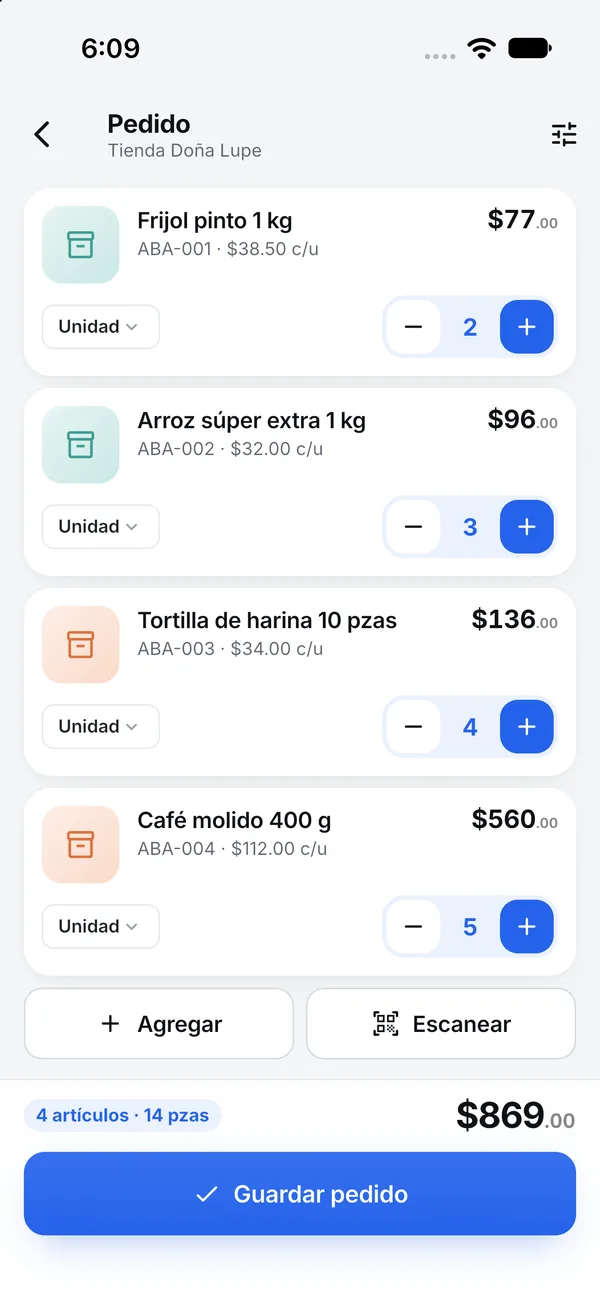
The driver presses Start route and enters the change float they carry. At each house they tap Arrived and sell. They collect on the spot or sell on credit if the customer has a limit.
-
8:00
The counter
At the plant the cashier sells refills and new jugs at the point of sale in touch mode, with one button per product. It draws from the same inventory as the route.
-
11:00
Dispenser service
At an office the driver opens Cooler / display, records the maintenance with a photo and temperature and notes how it was left.
-
13:00
Nobody home
If nobody answers, they leave the customer and pick a no-sale reason. If they won't make it down a street, they tap I will not visit it and pick a reason.
-
17:00
Settlement
In Settlements you enter what was counted on the truck and the cash handed in. What's left goes back to the warehouse or stays on the truck for tomorrow.
The app works where there's no signal
The first time the driver logs in, the app downloads customers, items, prices and stock. From then on it works without data. Sales and payments are saved on the phone and sent on their own when the signal comes back.
Each operation carries its own key. If the signal drops just as the app was sending a sale and it goes out twice, Nori records it only once.
In More › Synchronization the driver sees how many operations are waiting. With a paired Bluetooth printer they print the receipt on the spot, and in Mexico, if the sale was invoiced, the receipt includes the QR code of the CFDI (Mexico's e-invoice).
What a water plant uses most
-
Frequency by customer
Every week, every two weeks, certain days or only on request. Also the time window when the customer can receive.
-
Routes on the map
In the route designer, Split by days divides the area into zones and Optimize order tells you how many kilometers you save.
-
Loaned equipment
Each dispenser, cooler or freezer goes on the customer record with its service history. Nori tells you when maintenance is overdue.
-
Businesses on credit
Offices and restaurants with their own limit. The driver collects open invoices during the visit and the payment goes to the oldest first.
-
Reconciled by item
Settlement compares what the truck should have against what was counted, and differences go into inventory with their cause.
Frequently asked questions
Does the driver need mobile data?
Only for the first catalog download and to send what's pending. During the route they can sell and collect without signal.
Can I sell at the counter and deliver to homes?
Yes. The counter uses the point of sale and the drivers use the app. Both draw from the same inventory.
How do I know where each truck is?
In Route sales › Day board you see, by route, the visits done, the last visit and the next stop on the map. Each visit stores its GPS location.
Do I have to invoice every jug?
No. In Mexico, what's sold with a receipt to the general public goes into the global invoice. A business that asks for an invoice gets it at the time of sale.
Does it work for an ice plant?
Yes. Bags of ice are items like any other, they're loaded on the truck with their forecast, and the freezers you lend are recorded as loaned equipment.
Related guides
- Design routes and plan the daySet up each route with its CEDIS and truck, place customers on the map with their visit frequency, and generate the day plan and truck load every morning.
- Work the route and settleWhat the sales rep does at each stop from their phone, the supervisor's live board, and settling the truck and the cash at the end of the day.
- Install and set up the mobile appHow a sales rep or warehouse worker signs in to the Nori app, how it works with no signal, and what to do when you switch phones or users.
Want to see it with your products?
We'll show you Nori with a catalog and routes like yours.