Korima POS or Nori: which one fits your business
Korima POS is a free point of sale for micro businesses and Nori is a full ERP for companies: accounting, route sales, inventory, purchasing and e-invoicing. Both come from the same team. Here is how to pick one.
In this article
People often ask us which of our two systems they should use. Korima POS and Nori are made by the same team, and both names come from Rarámuri: korima means sharing, the custom of helping without expecting anything back, and nori means cloud. They solve different problems, so the answer depends on where your business is today.
What Korima POS is
Korima POS is a free point of sale for phone and web. You sell, track your inventory, give credit to customers and publish an online catalog, with no paid plans or commissions. More than 5,800 businesses in 21 countries have signed up.
It is built for micro businesses: the corner store, the small shop or the business that is just starting and wants to leave the notebook behind without a monthly fee.
What Nori is
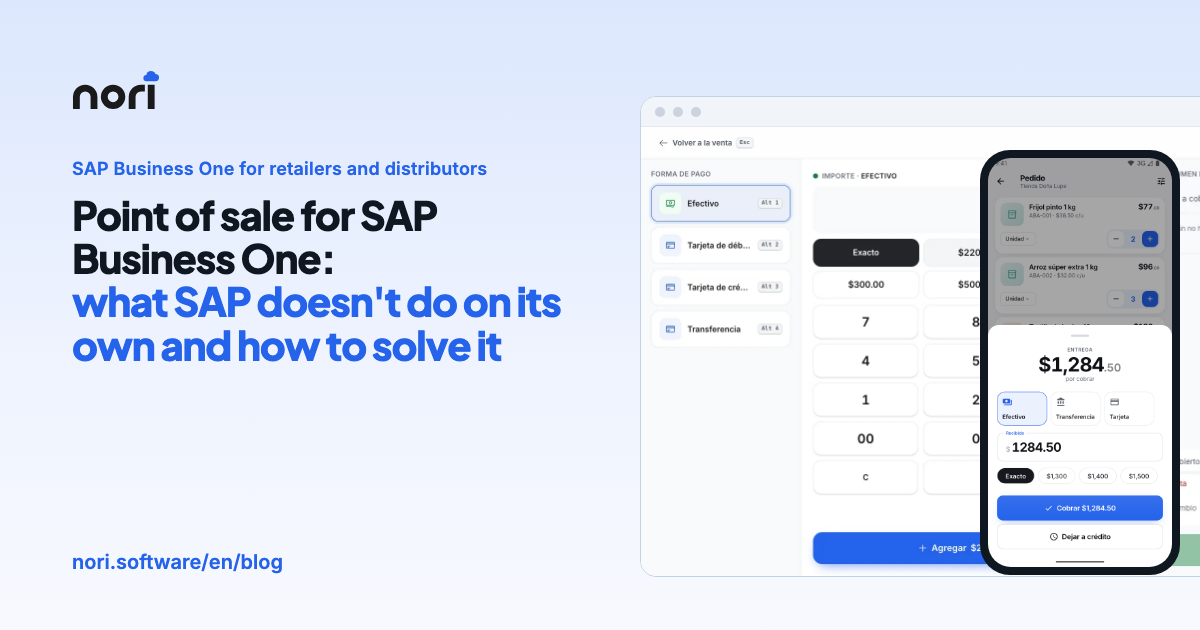
Nori is a cloud ERP for companies that already run a formal operation: several registers or branches, sellers on the road, warehouses, an accountant who closes every month. It puts in one system what a micro business handles by hand:
- Accounting with automatic journal entries from sales, purchases, collections and payments, a chart of accounts mapped to the SAT grouping code, and financial statements.
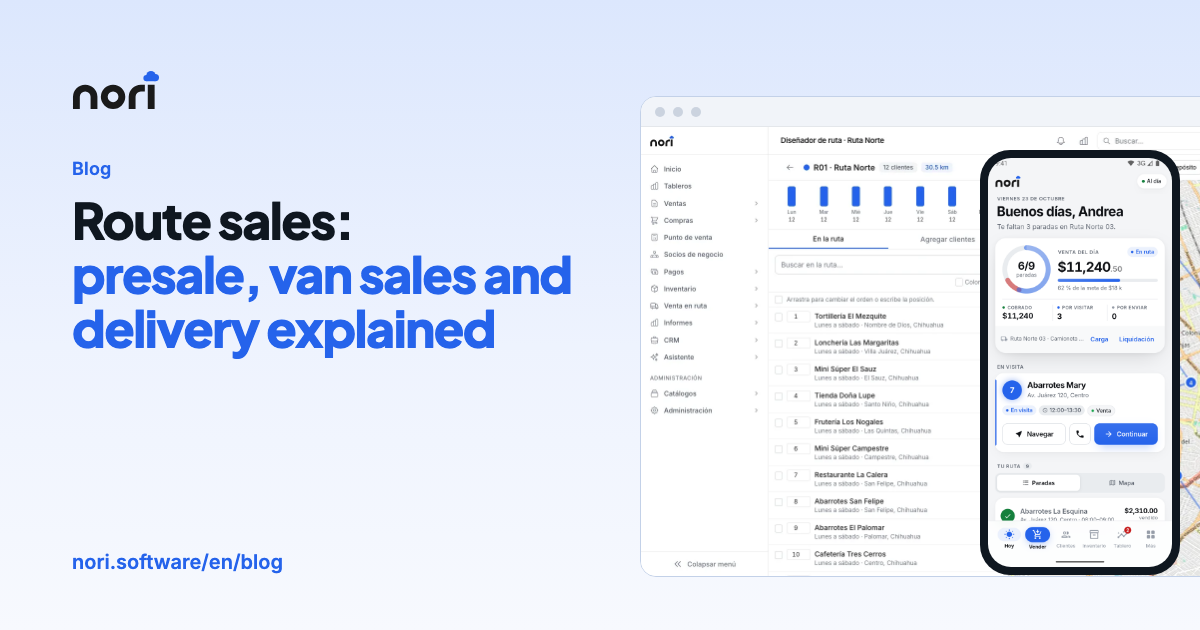
- Full route sales: routes and visit frequencies on the map, truck loading from the warehouse, a seller app that works without signal, collections, returns and a settlement with cash count on the way back.
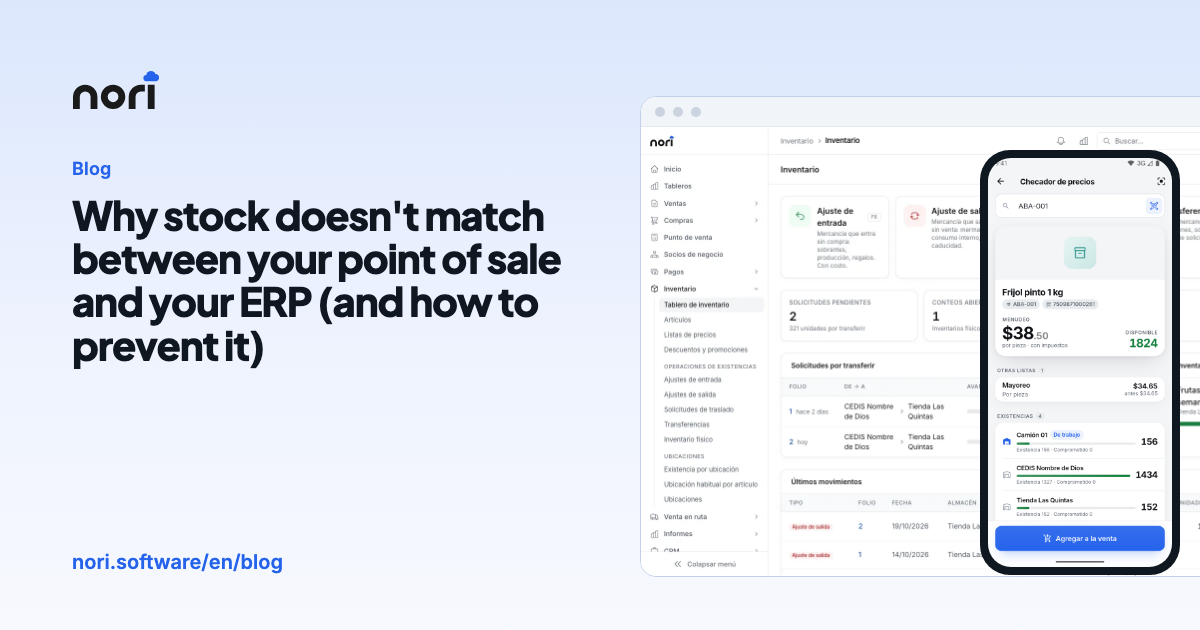
- Real inventory: several warehouses with transfers and goods in transit, batches, serial numbers and bins, stock committed by orders, and physical counts.
- Purchasing and production, with costs and receipts that feed the inventory.
- CFDI 4.0 e-invoicing from the register and the road, with payment complements, credit notes and Carta Porte.
- A connection to your ERP, if you already run SAP Business One, NetSuite or Microsip, so sales, payments and inventory are never typed twice.
How to decide
If you are a micro business that sells at the counter or over WhatsApp, tracks its inventory and gives credit, Korima POS is enough and costs nothing. Many businesses stay there for years, and that is fine.
The time to move to Nori comes when the business already runs like a company:
- customers ask for an invoice on every sale and your accountant needs everything in the books without typing it again;
- you have sellers on the street and need to know what they loaded, sold, collected and brought back;
- you handle several warehouses, batches or expiry dates, and inventory has to match what is on the shelf;
- you buy, produce, or keep price lists, promotions and credit rules per customer;
- you already run an ERP and want the register, the road and the warehouse to work connected to it.
What each one costs
Korima POS is free. Nori is paid per license once, by user type, plus a yearly maintenance of 18 % on active licenses. The connector to your ERP is included. Details and a calculator are on the pricing page.
If you start with Korima POS
It is a good start. When your operation grows, write to us and we will move your catalog and customers to Nori together. And if you know a business that only needs to sell and track its inventory, point them to Korima POS: it will not cost them a thing.
Frequently asked questions
Is Korima POS really free?
Yes. It has a single plan, and it is free, with no commission per sale.
Does Korima POS issue e-invoices?
No. Many businesses on Korima POS invoice separately on the SAT portal or through their accountant. If you need to stamp a CFDI 4.0 at the moment of the sale, Nori does that.
Can I start with Korima POS and move to Nori later?
Yes. That is the natural path for a growing business: start at no cost and switch when invoicing, the ERP or route sales call for it.
Does Nori have a point of sale too?
Yes, as part of a full ERP: counter checkout, route sales app, inventory, purchasing, production, accounting and invoicing, and it connects to the ERP you already use.